





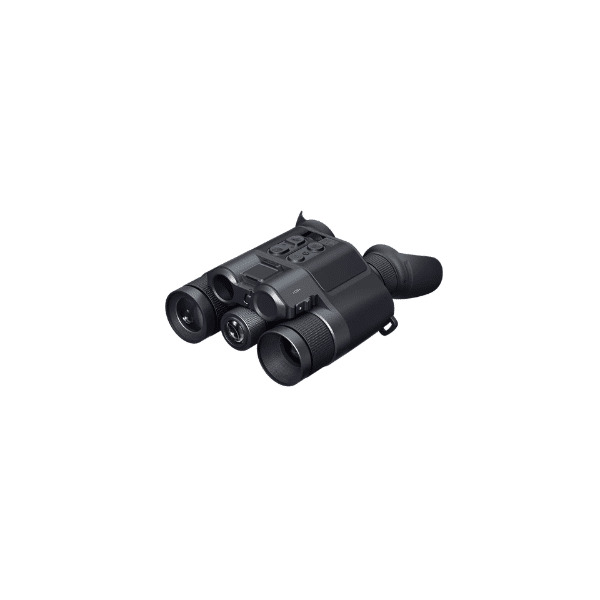
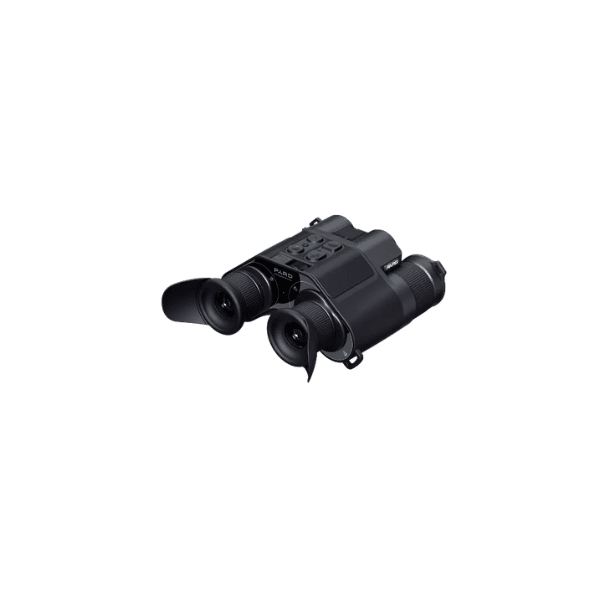




PARD Osprey 4K Multispectral Binoculars LRF | 25/50 mm | 850/940 nm IR | OS4-25/50/LRF
R22,500.00
PARD Osprey 4K Multispectral Binoculars LRF | 25/50 mm | 850/940 nm IR
The PARD Osprey 4K OS4-25/50/LRF combines thermal imaging, true 4K digital day and night vision, infrared illumination and laser rangefinding in one advanced multispectral binocular.
This 25/50 mm configuration uses a 256 × 192 thermal sensor with a 25 mm thermal objective, together with a 3840 × 2160 4K digital day/night channel and 50 mm objective lens. The thermal channel allows you to locate heat sources quickly, while the high-resolution digital channel provides the visual detail needed for clearer identification during daylight or after dark.
An integrated laser rangefinder measures distances up to approximately 1,000 metres, while the dual-screen binocular design provides a comfortable viewing experience during longer observation sessions.
The Osprey 4K also uses a removable and interchangeable infrared illuminator, and you can choose between 850 nm or 940 nm IR when ordering.
Choose Your IR Wavelength
Your Osprey 4K can be supplied with either:
- 850 nm IR Illuminator
- 940 nm IR Illuminator
Both options use the detachable PARD IR system, so the illuminator can be removed when it is not required or changed when using another compatible IR module.
The main difference between 850 nm and 940 nm comes down to night-vision performance versus concealment. Neither wavelength is automatically better for every customer, so the right option depends on how you intend to use the binoculars.
850 nm vs 940 nm – Which One Should You Choose?
Choose 850 nm for Maximum Range and Image Performance
The 850 nm IR illuminator is the better choice when your priority is a brighter night-vision image, stronger illumination and the best practical range.
Digital night-vision sensors generally respond more efficiently to 850 nm infrared light, which means the image can remain brighter and clearer at greater distances.
This makes 850 nm especially suitable for:
- Long-range wildlife observation
- Open fields and larger outdoor areas
- General night observation
- Security and property monitoring
- Situations where maximum image brightness is important
- Longer-range use where stronger IR illumination is preferred
The main trade-off is that an 850 nm illuminator can produce a faint red glow at the LED source when viewed directly.
This glow is small, but it means the light source is not completely invisible at close range.
Choose 940 nm for More Discreet Observation
The 940 nm IR illuminator is the better choice when remaining discreet is more important than achieving the greatest possible illumination range.
Its infrared output produces much less visible glow at the source, making it very difficult for the human eye to detect during normal use.
This makes 940 nm particularly useful for:
- Discreet wildlife observation
- Watching cautious or easily disturbed animals
- Security and surveillance
- Close-to-medium-range observation
- Situations where visible IR glow is undesirable
- Applications where concealment is more important than maximum range
The trade-off is that digital night-vision sensors are generally less sensitive to 940 nm light. This means the night-vision image may be darker and the practical identification range may be shorter than with the 850 nm version under the same conditions.
850 nm vs 940 nm Quick Comparison
| Feature | 850 nm | 940 nm |
|---|---|---|
| Image Brightness | Higher | Lower |
| Practical IR Range | Longer | Shorter |
| Detail at Distance | Better | Best at closer ranges |
| Visible Red Glow | Faint glow may be visible | Very difficult to see |
| Concealment | Good | Best |
| Long-Range Observation | Recommended | Less effective |
| Discreet Observation | Good | Recommended |
| General Night Vision | Recommended | Best when discretion matters |
Simple Recommendation
Choose 850 nm if you want the strongest night-vision performance, brighter image and longest practical range.
Choose 940 nm if you want maximum discretion and are willing to trade some image brightness and effective range for a less visible IR source.
For most general-purpose night observation, 850 nm offers the strongest overall performance. The 940 nm option is better suited to situations where avoiding a visible red glow is more important than achieving maximum distance.
Removable and Interchangeable IR Illuminator
The Osprey 4K does not rely on a permanently fixed infrared source. Instead, it uses a detachable IR illuminator, which gives you more flexibility in the field.
The IR unit can be removed when it is not needed, which helps reduce unnecessary weight during daytime or thermal-only observation.
The adjustable IR head allows the beam to be aligned with the viewing area, while PARD specifies IR illumination over distances of up to approximately 350 metres.
Your selected package will therefore include either:
- 850 nm removable IR illuminator
- 940 nm removable IR illuminator
Simply select your preferred wavelength before adding the Osprey 4K to your basket.
Thermal Detection
The thermal channel uses a 256 × 192 uncooled VOx sensor with a 12 µm pixel pitch and thermal sensitivity of NETD ≤15 mK.
Combined with the 25 mm thermal lens, this configuration is designed to provide useful thermal detection while maintaining a relatively broad field of view for scanning.
The 25 mm version is rated for thermal detection at approximately 1,200 metres, making it suitable for scanning fields, bush, property and outdoor areas for heat sources.
True 4K Day and Night Vision
Once a heat source has been located, the digital channel can be used for clearer visual identification.
The Osprey uses a 3840 × 2160 4K CMOS sensor together with a 50 mm digital objective lens, giving you a detailed day and night viewing channel in the same device.
The digital sensor offers low-light sensitivity down to approximately 0.001 lux, while Optical Image Stabilisation helps reduce movement during handheld observation and recording.
Integrated 1,000 Metre Laser Rangefinder
The built-in laser rangefinder allows you to measure distance without changing devices.
Its maximum range is approximately 1,000 metres, allowing the user to locate a subject thermally, inspect it using the 4K digital channel and then measure the distance through the same binocular platform.
Dual Full HD OLED Displays
The Osprey uses dual 1920 × 1080 OLED displays, allowing both eyes to view the image rather than relying on a single monocular screen.
This creates a more natural viewing experience and can reduce discomfort during longer observation periods.
The interpupillary distance can also be adjusted to suit different users.
Multiple Observation Channels
The multispectral design allows several observation methods to be combined in one unit.
Depending on the conditions, you can make use of:
- Thermal imaging
- Daylight digital imaging
- Low-light digital imaging
- IR-assisted night vision
This makes the Osprey useful across changing light and weather conditions without requiring several separate devices.
Photo, Video and Connectivity
The Osprey can capture photographs and video directly through the device.
Useful functions include:
- Photo recording
- Video recording
- Loop recording
- Built-in microphone
- Picture-in-picture
- Hot tracking
- Wi-Fi
- PARD Vision2 app connectivity
- Micro SD storage up to 128 GB
- Gyroscope
- Electronic compass
These functions make it easier to record and review observations while keeping everything within one handheld platform.
Battery and External Power
The Osprey uses 1 × rechargeable 21700 lithium-ion battery.
The battery is removable and rechargeable, while USB Type-C external power support allows the unit to be powered from a suitable external source when required.
Actual battery life will vary according to display settings, recording, Wi-Fi, IR use, temperature and other active functions.
IP67 Outdoor Protection
The Osprey carries an IP67 protection rating, helping protect the electronics against dust and normal outdoor exposure to water.
Its aluminium-alloy and composite housing is designed for regular outdoor use, while the compact binocular format makes it suitable for extended observation sessions.
Product Features
- Multispectral thermal and 4K digital binocular system
- 256 × 192 thermal sensor
- 12 µm thermal pixel pitch
- NETD ≤15 mK
- 25 mm thermal objective lens
- Thermal detection distance up to approximately 1,200 m
- 3840 × 2160 4K digital sensor
- 50 mm digital day/night objective lens
- Optical Image Stabilisation
- Removable and interchangeable IR illuminator
- Choice of 850 nm or 940 nm IR
- 850 nm for stronger range and image performance
- 940 nm for more discreet illumination
- Adjustable IR beam
- IR illumination up to approximately 350 m
- Dual 1920 × 1080 OLED displays
- Integrated laser rangefinder
- LRF distance up to approximately 1,000 m
- Picture-in-picture
- Hot tracking
- Gyroscope
- Electronic compass
- Photo and video recording
- Built-in microphone
- Wi-Fi connectivity
- PARD Vision2 app support
- Micro SD support up to 128 GB
- Replaceable rechargeable 21700 battery
- USB Type-C external power
- IP67 protection
Specifications
- Brand: PARD
- Model: Osprey 4K
- Model Code: OS4-25/50/LRF
- Product Type: Multispectral Binoculars
- Thermal Sensor Type: Uncooled VOx
- Thermal Resolution: 256 × 192
- Thermal Pixel Size: 12 µm
- NETD: ≤15 mK
- Thermal Frame Rate: 50 Hz
- Thermal Lens: 25 mm
- Thermal Detection Distance: Up to approx. 1,200 m
- Visible Sensor: CMOS
- Visible Sensor Resolution: 3840 × 2160
- Visible Sensitivity: 0.001 lux
- Visible Frame Rate: 50 Hz
- Visible Lens: 50 mm
- IR Illuminator: Removable / Interchangeable
- IR Wavelength: 850 nm or 940 nm
- IR Illumination Distance: Up to approx. 350 m
- IR Beam: Adjustable
- Display Type: Dual OLED
- Display Resolution: 1920 × 1080
- LRF: Yes
- LRF Range: Up to 1,000 m
- Picture-in-Picture: Yes
- Hot Tracking: Yes
- Gyroscope: Yes
- E-Compass: Yes
- OIS: Yes
- Wi-Fi: Yes
- App: PARD Vision2
- Storage: Micro SD up to 128 GB
- Battery: 1 × Rechargeable 21700 Li-ion
- External Power: USB Type-C
- IP Rating: IP67
Package Includes
The package includes:
- 1 × PARD Osprey 4K OS4-25/50/LRF Binocular
- 1 × Detachable IR Illuminator in Your Selected Wavelength
- 1 × Rechargeable 21700 Li-ion Battery
- 1 × Protective Carry Case
- 1 × USB Type-C Cable
- 1 × Neck Strap
- 1 × Lens Cleaning Cloth
- 1 × User Manual
- 1 × After-Sales / Warranty Card
Select Your IR Option
When ordering, choose:
850 nm IR
For stronger image brightness, greater practical night-vision range and maximum general-purpose performance.
940 nm IR
For more discreet night observation with very little visible glow from the IR source.
Care and Maintenance
Keep the thermal and digital objective lenses clean and free from dust, moisture and fingerprints. Use a soft optical lens cloth and avoid harsh or abrasive cleaning products that could damage the optical coatings.
Keep the battery contacts, USB-C port, Micro SD slot and IR connection clean and dry. The detachable IR module should be fitted and removed carefully so that its contacts and mounting system remain protected.
Remove the battery during long periods of storage and keep the binoculars in their protective case when they are not being used.
Only use suitable batteries, accessories and firmware intended for the PARD Osprey platform.
Manufacturer Information
The Osprey 4K is manufactured by PARD, a specialist manufacturer of thermal imaging, digital night vision and multispectral observation equipment.
Visit the official PARD website for further product information, manuals, firmware and technical support.
You can also browse Dye-Hard’s PARD Night Vision & Thermal Scopes range for additional PARD thermal, night-vision and multispectral products.
Conclusion
The PARD Osprey 4K OS4-25/50/LRF combines thermal detection, detailed 4K day and night vision, infrared illumination and laser rangefinding in one compact observation platform.
Its 25 mm thermal channel provides a useful balance between detection range and field of view, while the 50 mm 4K digital channel provides clearer visual identification once a heat source has been located. The integrated 1,000 metre LRF, dual OLED displays, recording functions and wireless connectivity add even more versatility.
The choice between a removable 850 nm or 940 nm IR illuminator also lets you configure the Osprey around the way you intend to use it. Choose 850 nm when image brightness and longer practical night-vision range are the priority, or select 940 nm when discreet observation matters more.
Frequently Asked Questions
Can I choose between 850 nm and 940 nm IR?
Yes. Select either an 850 nm or 940 nm detachable infrared illuminator when ordering your Osprey 4K.
What is the difference between 850 nm and 940 nm IR?
The 850 nm option normally provides a brighter image and better practical range, while the 940 nm option provides more discreet illumination with much less visible red glow.
Which IR wavelength is best for long-range use?
Choose 850 nm if maximum image brightness, clarity and practical night-vision distance are your main priorities.
Which IR wavelength is best for discreet observation?
Choose 940 nm when reducing visible IR glow is more important than achieving the maximum possible range.
Can the IR illuminator be removed or changed?
Yes. The Osprey 4K uses a removable IR illuminator, allowing the IR module to be detached or exchanged for a compatible alternative wavelength.
| Brand | Pard |
|---|---|
| Colour | Black |
| Product Type | PARD Night Vision & Thermal Scopes, Scopes & Optics |
| IR Wavelength | 850 nm, 940 nm |
| IR Illuminator | Removable / Interchangeable |
| IR Illumination Distance | Up to 350 m |
| 850 nm Positioning | Brighter image / longer practical range |
| 940 nm Positioning | More discreet / minimal visible glow |
| Thermal Sensor | 256 × 192 |
| Thermal Lens | 25 mm |
| Thermal Detection Distance | Approx. 1,200 m |
| Digital Sensor | 3840 × 2160 |
| Digital Lens | 50 mm |
| LRF | Up to 1,000 m |
| Battery | 21700 Li-ion |
| IP Rating | IP67 |
PARD
PARD is an optics brand known for night vision, thermal imaging and multi-spectral devices.
The range includes night vision scopes, clip-on units, thermal scopes, monoculars and binoculars. PARD also makes accessories for many of its devices.
PARD products are made for users who need better vision in low light or complete darkness. Different models are designed for hunting, shooting, outdoor use and security work.
The night vision range includes digital scopes and clip-on units. These allow users to see more clearly after dark while keeping a compact setup.
PARD also offers thermal imaging products. Thermal devices detect heat rather than visible light. This can make it easier to find animals or other heat sources in dark or difficult conditions.
Some PARD products combine more than one imaging system. These multi-spectral models can offer both thermal and night vision in one device.
Dye-Hard Paintball stocks selected PARD products in South Africa. Our range includes night vision, thermal optics and related accessories.
Browse our PARD Night Vision & Thermal Scopes range to view available PARD products.
For more information about the brand and its current range, visit the PARD official website.